From the notebook
Who created the world?
Why do people pray?
Why do difficult things happen?
What does it mean to be a good human being?
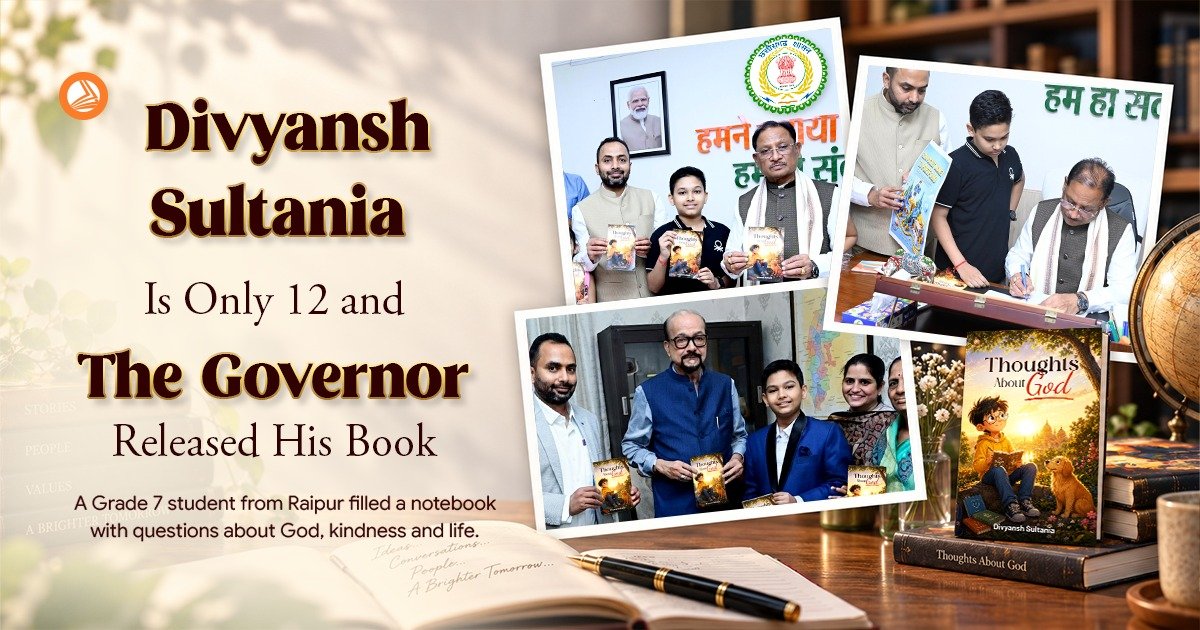
A Grade 7 student in Raipur wrote those down. Not for a school assignment — for himself, in a notebook he kept going back to.
In August 2026 the Governor of Chhattisgarh released the book that came out of it. A few days later the Chief Minister was handed a copy.
Divyansh Sultania is twelve.
Divyansh Sultania with the book that began as a notebook.
Where it started
❓ The Age When Children Stop Asking
Nearly every child asks these questions at seven or eight. Almost all of them stop by eleven, and not because they work out the answers. They stop because of what comes back: because that is how it is, you will understand when you are older, do not ask such things.
Divyansh got something else. His grandfather encouraged him to write the questions down instead of putting them away — and a notebook is a very different response to a curious child than a closed conversation. One says enough. The other says keep going, this is worth keeping.
What makes the book unusual is what he does next. He does not try to answer any of it. He says so plainly — he is not offering conclusions, and he does not think a twelve-year-old should. His argument is that asking a good question is itself a part of growing up, and that curiosity teaches you as much as an answer does.
He did not write a book because he had answers. He wrote one because he had questions, and nobody told him that was not allowed.
Most adult non-fiction is too insecure to take that position. It is a strange thing to learn from a Grade 7 student, and it is the reason the book works.
There is an Indian texture to this that anyone who grew up here will recognise. Questions about God are not abstract in most Indian homes — they arrive alongside a grandmother’s evening prayer, a festival nobody quite explains the origin of, a temple visit before an exam, an argument at a family lunch. A child in Raipur is surrounded by faith as practice long before anyone offers a reason for it. Writing the questions down is what turns all that noticing into something you can hold.
The book
📘 Thoughts About God
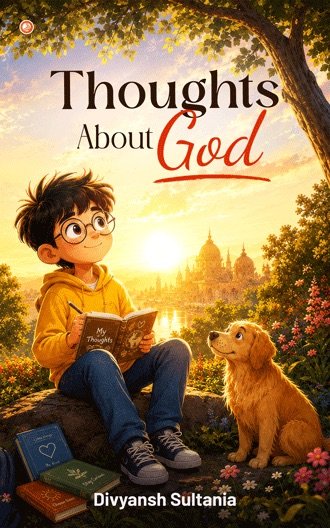
By Divyansh Sultania
Thoughts About God
A memoir-shaped journey through the questions a curious twelve-year-old actually has. No lectures, no theories, no tidy conclusions — just the conversations and small observations that shaped what he thinks. He learns from his parents, his grandmother, his teachers, his friends, and from the ordinary moments most people walk past. The notebook goes everywhere with him and becomes the book.
ISBN 978-93-7426-123-1 · Paperback and eBook · 5 x 8 in · English · Non-fiction
It is written for young readers and for the families around them, which is a harder brief than it sounds. A book about faith and kindness by a child could very easily become either a sermon or a novelty. This one stays a notebook.
Who it is for
📕 Not a Book About Religion
Worth saying clearly, because the title will make some readers assume otherwise. This is not religious instruction. It does not teach a faith, argue for one, or tell anyone what to believe. It is a book about wondering — which is a different subject entirely, and one that belongs to every household regardless of what is or is not practised in it.
Readers of nine to fourteen
Short chapters, plain language, and a narrator their own age who admits when he does not know something.
Families who read together
It starts conversations rather than closing them. Most of the questions in it are ones a parent has been asked at a dinner table.
Adults who stopped asking
A reminder of how these questions felt before they became embarrassing to say out loud.
The release
🏛 Raj Bhavan, and Then the Chief Minister
On 14 August 2026 the Governor of Chhattisgarh, Shri Ramen Deka, formally released Thoughts About God. He praised the creative effort behind it and wished Divyansh well for the future. His parents, Sudhir and Sarita Sultania, were there.
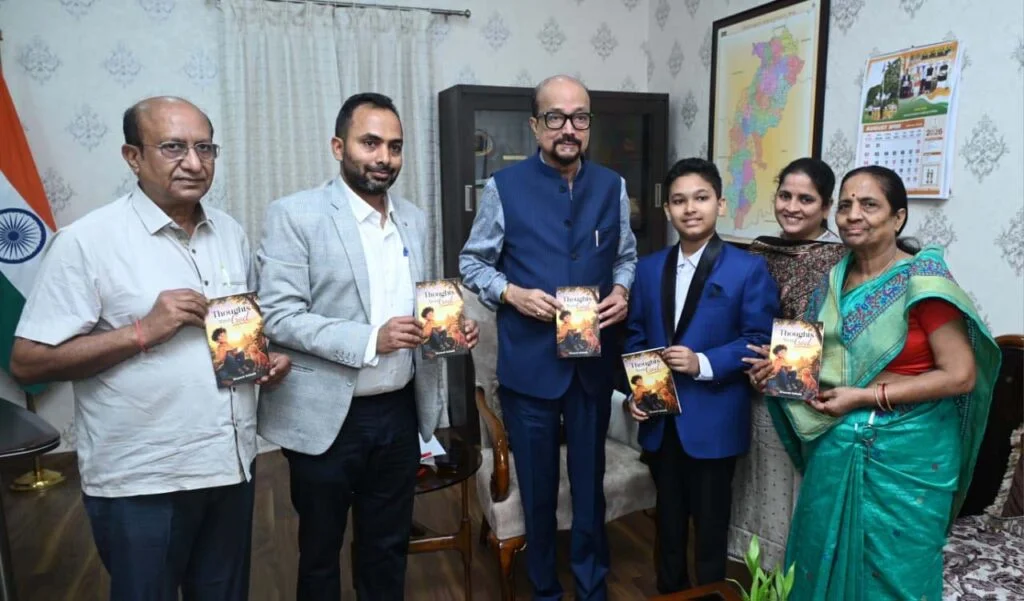
The release of Thoughts About God by the Governor of Chhattisgarh.
According to the report of the event, the Governor said that building habits of reading, writing and thinking about new subjects plays an important part in forming a child’s personality, and he encouraged Divyansh to keep his curiosity and his appetite for learning going.
That is worth sitting with for a moment. The head of state of Chhattisgarh spent an afternoon telling a twelve-year-old that his questions were worth having.
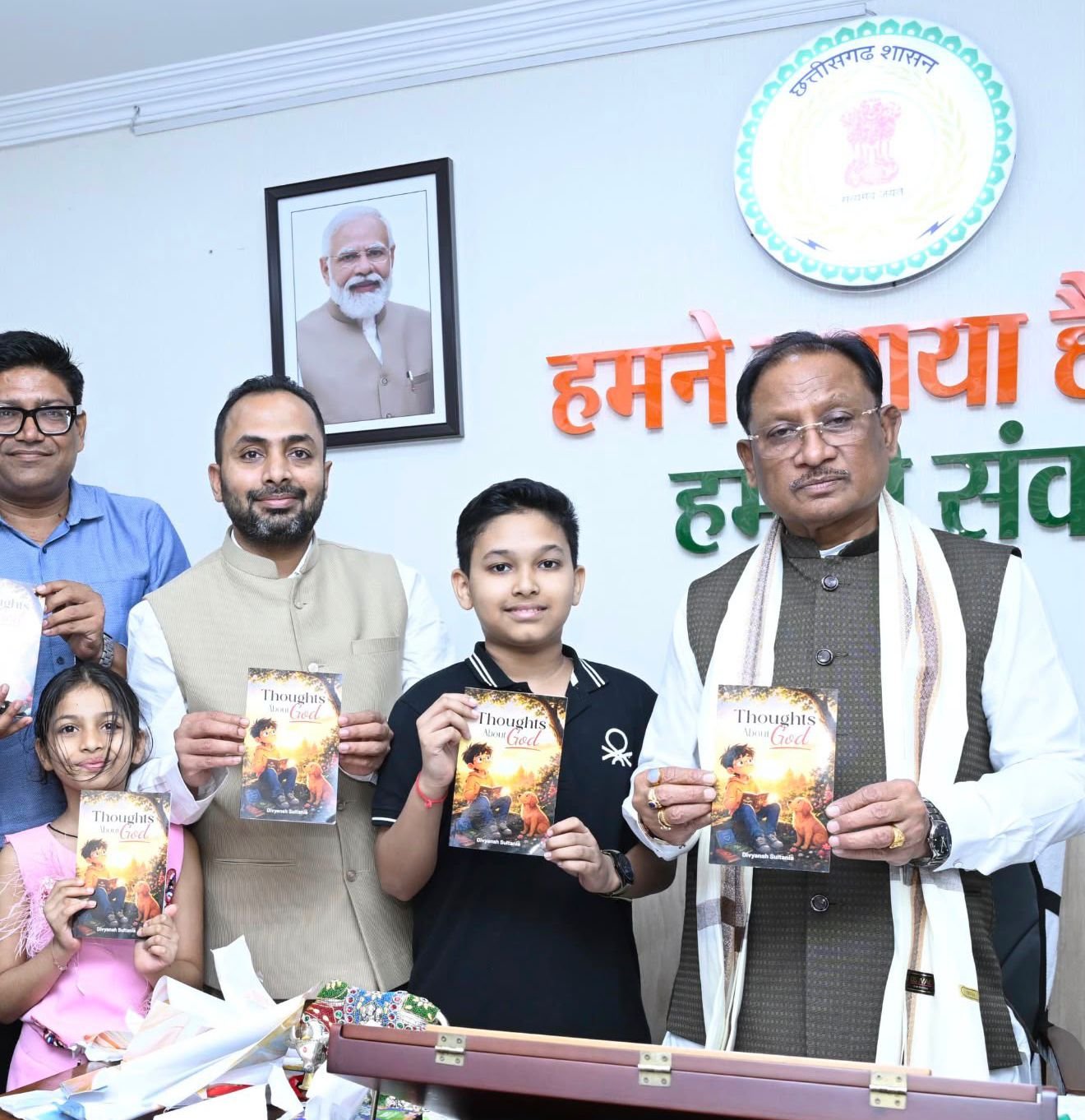
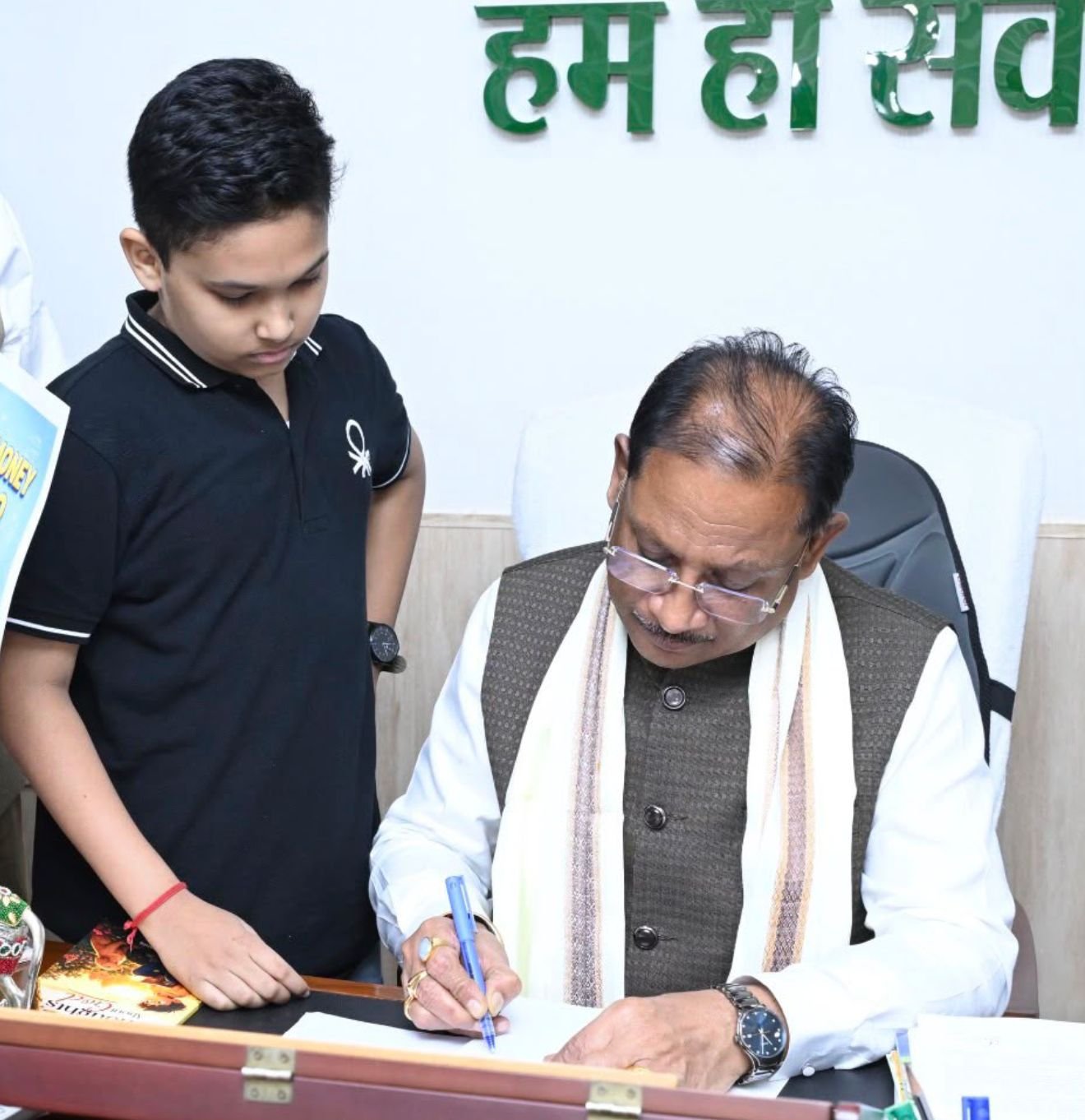
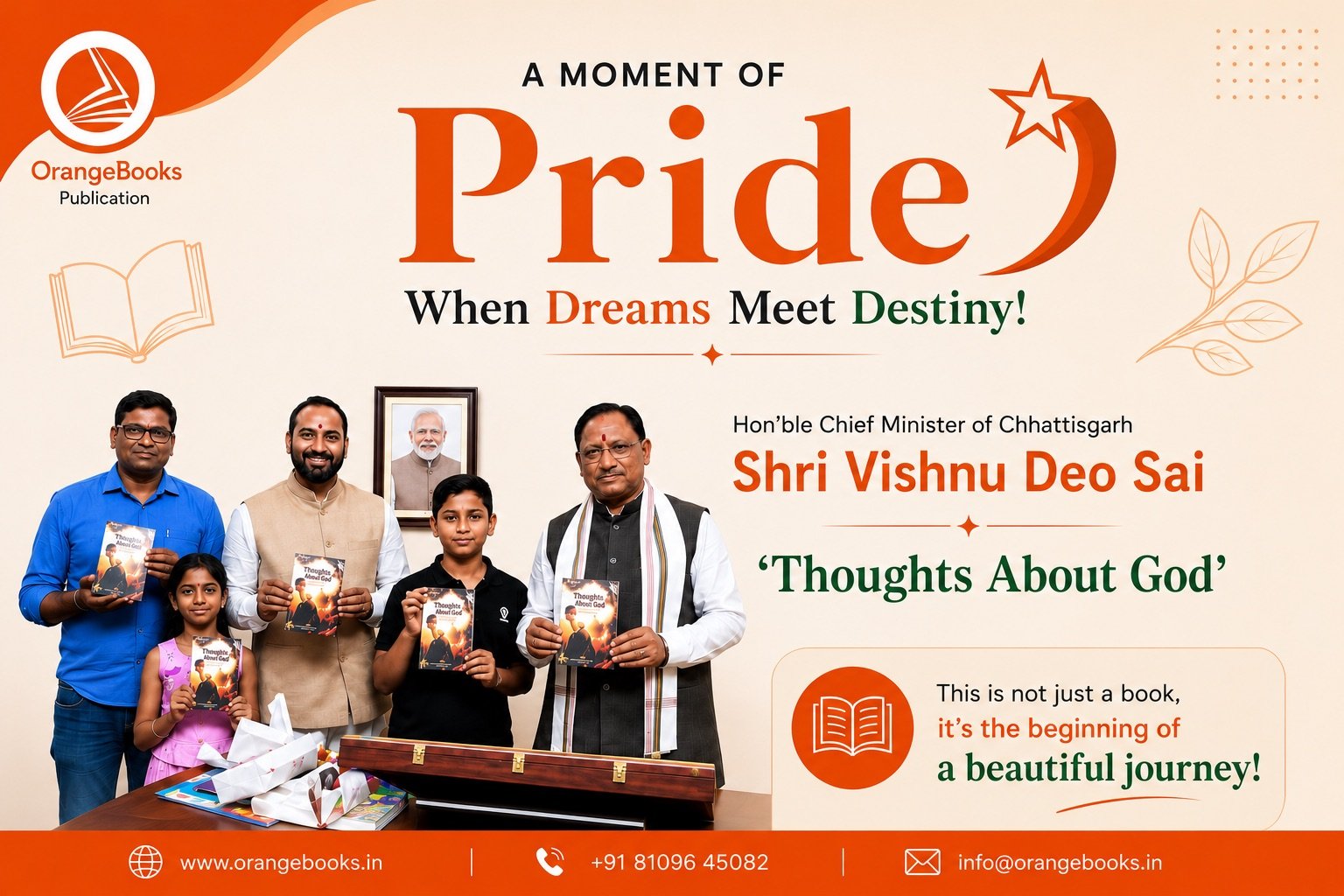
Copies handed to the Chief Minister, Shri Vishnu Deo Sai, who sent his best wishes.
Two offices, two occasions, one Grade 7 student holding his own book in both photographs. Most authors publish a first book and hope a bookshop takes ten copies. His first month included the Raj Bhavan and the Chief Minister’s office.
None of that happens because a child wrote something. It happens because there is a finished, printed, properly published book to hand over. A notebook cannot be released by a Governor. That is the unglamorous mechanical truth underneath every author story on this site: the ceremony follows the object, and the object follows somebody finishing the work.
Production
🛠 What OrangeBooks Handled
A first book by a twelve-year-old has one production problem above all others: it has to look like a real book. Anything that reads as a school project undoes the writing.
🏷 ISBN in his own name
Registered properly, so libraries, retailers and catalogues treat it as a book rather than a keepsake.
📄 A 5 x 8 trim
The right size for a short reflective read — pocketable, unintimidating, and not a picture book.
🎨 A cover that respects the reader
Warm and illustrated without tipping into cartoon. It signals a young author, not a childish book.
🌎 Paperback, eBook, worldwide
Print and digital together, with international availability so relatives and readers abroad can order it.
✅ Rights — the book belongs entirely to its author. OrangeBooks takes no ownership and no share of the royalties.
If this sounds familiar
✍ If Your Child Fills Notebooks
We are in Bhilai. Divyansh is in Raipur, about twenty-five kilometres away. A Chhattisgarh child, a Chhattisgarh publisher, and the Chhattisgarh Governor holding the result — there is something quietly good about that, and it is more reachable than it looks from the outside.
The youngest authors we have published have one thing in common, and it is not talent or connections. They finished. A notebook of questions is not a book; a notebook someone kept returning to for a year becomes one. Age has never been the obstacle. The obstacle is always the last twenty pages.
The other thing worth saying to a parent: publishing a child’s book is not about expecting sales. Divyansh’s book will find the readers it finds. What it has already done is more durable — it has told a twelve-year-old that his thinking was worth printing, and it has handed him a finished thing with his name on it at an age when most people are still being marked out of ten.
If there is a child in your house who writes and will not stop, the practical parts are smaller than you think — the ISBN is free in India, and getting the finished book into shops and online is a solved problem. The part nobody can do for them is the writing, and that is the part they are already doing.
Has your young writer finished something?
We handle the ISBN, editing, cover, printing and distribution. Over 3,100 authors published — the youngest of them still in school.
More young authors
🔥 Avni Agrawal
In Class 11, and she wrote the book on the pressure her generation lives with.
✨ Niharika Jishnu
A debut poetry collection at eighteen, written from Tokyo, with a perfect rating on Amazon.
🎖 Vraj Adhiya
Four books across three genres in two years, starting while he was still in college.