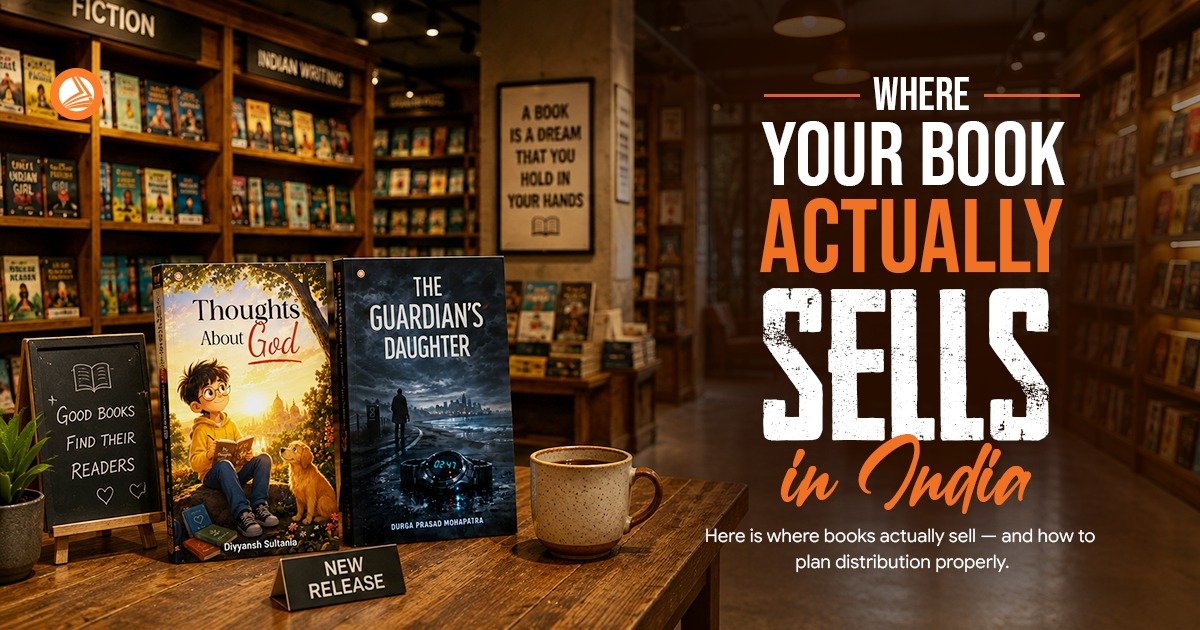
Most Indian authors carry the same picture in their head. Their book, face out, on a shelf in a bookshop they have walked past for years. It is a lovely image, and nobody explains what it costs to put there — or how few copies it moves once it is.
Distribution is the least understood part of self-publishing in India and the part that decides everything. You can write a good book, design a good cover, price it sensibly, and still sell forty copies because nobody thought about where it would live once it existed.
The honest version: where Indians actually buy books now, what each channel is worth, what bookstores really involve, and the order to do things in.
The short version
Roughly two-thirds of Indian book sales now happen online. The shelf is the most expensive and least productive channel available to a first-time author. Start where the buyers already are.
Where Indians Actually Buy Books Now
The market moved and the mental picture did not. Well over half of book purchases in India now happen on a phone. Flipkart alone moves around 55,000 books a day, and Amazon India carries a catalogue no shop could hold — with a search box that puts a first-time author on the same page as a bestseller if the metadata is right.
This is good news for a self-published author. Shelf space is finite and expensive; search results are not. A reader looking for a book on managing a small business in Marathi, or on living with a rare eye condition, will find yours if it is listed properly — and would never have found it in a shop.
Your distribution effort belongs where the buying already happens, in roughly that proportion. Most authors invert it — months chasing shelves, an afternoon on the Amazon listing.
The Five Channels, Rated Honestly
Every channel costs something — money, time, or margin. Here is what each is actually worth to a first book.
Amazon India
The default and, for most first books, the majority of sales. Paperback and eBook both. Worth more attention than any other channel — your title, description and category choices do more work here than any marketing you will pay for.
Flipkart
Consistently underrated by authors and heavily used by readers in tier-two and tier-three cities. If your book is regional, practical or priced for a wide audience, Flipkart often outperforms expectations.
eBook platforms
Kindle and Google Play Books. Almost no marginal cost once the file exists, the best margins of any channel, and the only format that reaches Indian readers abroad instantly. There is no good reason to skip it.
Your publisher’s own store
Small volumes, best economics. This is the link you send to your own network, at events, and in your email signature — the people who were going to buy anyway should buy here.
Physical bookstore chains
Highest emotional value, lowest commercial return. Paid placement exists and is expensive; ordinary consignment gives the shop most of the cover price and returns unsold copies. Understand it properly before spending anything.
The Bookstore Question
This is the one every author asks, so here is the arithmetic nobody volunteers.
What the shelf actually costs
Several lakh rupees for a few months, across a handful of stores.
That is the going rate for paid placement at major chains. To break even you would need to sell more copies from those shelves than most traditionally published books manage — and placement carries no promise that anyone picks the book up.
Where placement is not paid, the terms are consignment: the store keeps 40 to 50 per cent of the cover price, pays only for what sells, and returns the rest. Stock that sits for three months costs the shop money, which is why buyers are ruthless. A debut with no track record is a poor bet — a commercial judgement, not a slight.
The bookstore route that does work: independent shops in your own city. Walk in with copies, talk to the owner, offer consignment, and bring people to the shop for a small reading or signing. Ten copies in a shop that hosts you and mentions you to customers beat a hundred sitting anonymously in a chain — and it costs an afternoon.
Print-on-Demand or a Print Run?
The decision first-timers get wrong most often, usually because a per-copy price looked attractive.
Print-on-demand
A copy is printed when someone orders it. No upfront print cost, no storage, no unsold stock, and the book can stay available for years without further spend.
Higher cost per copy, so slightly thinner margins. Correct for almost every first book.
A printed batch
Cheaper per copy at volume, and you hold stock you can sell or hand out immediately. Makes sense when you already have confirmed demand.
Money is committed before a single sale, and boxes in a spare room are the most common regret in Indian self-publishing.
A simple rule: print a batch only against orders you can already name — a library, an event, a corporate buyer. Otherwise let print-on-demand carry the risk. For the full cost picture, see our self-publishing cost guide and the pricing and royalty guide.
What “Worldwide Distribution” Actually Means
Every publisher in India uses the phrase and few explain it, leaving authors imagining crates of books crossing oceans. It describes a listing and printing network.
At OrangeBooks, international reach runs through Ingram, the largest book distribution network in the world. Your title enters their catalogue — what retailers, wholesalers and libraries across the US, UK, Europe and Australia order from. When a reader in Ohio buys your book, it is printed near them and shipped locally. Nothing travels from India.
Be clear what this is not. It means your book is available anywhere and can be ordered by any bookshop that wants it. It does not mean it is sitting on shelves in London. The real value is specific: diaspora readers abroad can actually buy it, and an overseas institution can order it without an import headache.
The Order to Do It In
For a first book, sequence matters more than ambition. This is the order that wastes the least money.
01
Get the ISBN
Nothing lists anywhere without it. Free in India, but allow a few weeks.
02
eBook plus POD paperback
Both formats from day one. No stock, no risk.
03
Amazon and Flipkart live
Then spend real time on the listing itself, not on marketing.
04
International listing
Ingram catalogue, so anyone abroad can order it.
05
Your own direct link
For your network, events and email signature. Best margin you will get.
06
Local independents
Only after the above. Consignment, and offer them an event.
Notice what is missing: paid chain placement. It belongs after a second or third book, if at all, and only with a sales record to justify it. Our guides on selling your first 100 copies and why self-published books fail cover what to do with the attention once the channels are live.
Frequently Asked Questions
How much does it cost to get a self-published book into Indian bookstore chains?
Paid placement programmes at major chains run into several lakh rupees for a limited period across a small number of stores. Ordinary consignment costs nothing upfront but gives the shop 40 to 50 per cent of the cover price and returns unsold copies to you. For a first book, neither is a sensible first move.
Do I need an ISBN to sell on Amazon and Flipkart?
Yes for any listing you want treated as a real book by retailers, libraries and distributors. In India an ISBN is free through the government agency, though approval takes a few weeks — apply well before your publish date. See our complete ISBN guide.
Is print-on-demand or a print run better for a first book?
Print-on-demand, in almost every case. It removes the upfront cost and the risk of unsold stock, and keeps the book available indefinitely. Print a batch only when you have specific confirmed orders — an institution, an event, a bulk buyer.
Distribution, handled
Your book on Amazon, Flipkart, Google Play and the Ingram network — without you managing any of it.
OrangeBooks has published over 3,100 authors with print-on-demand production, national retail listing and international availability through Ingram. Transparent pricing, full royalty clarity, and every right stays with you.