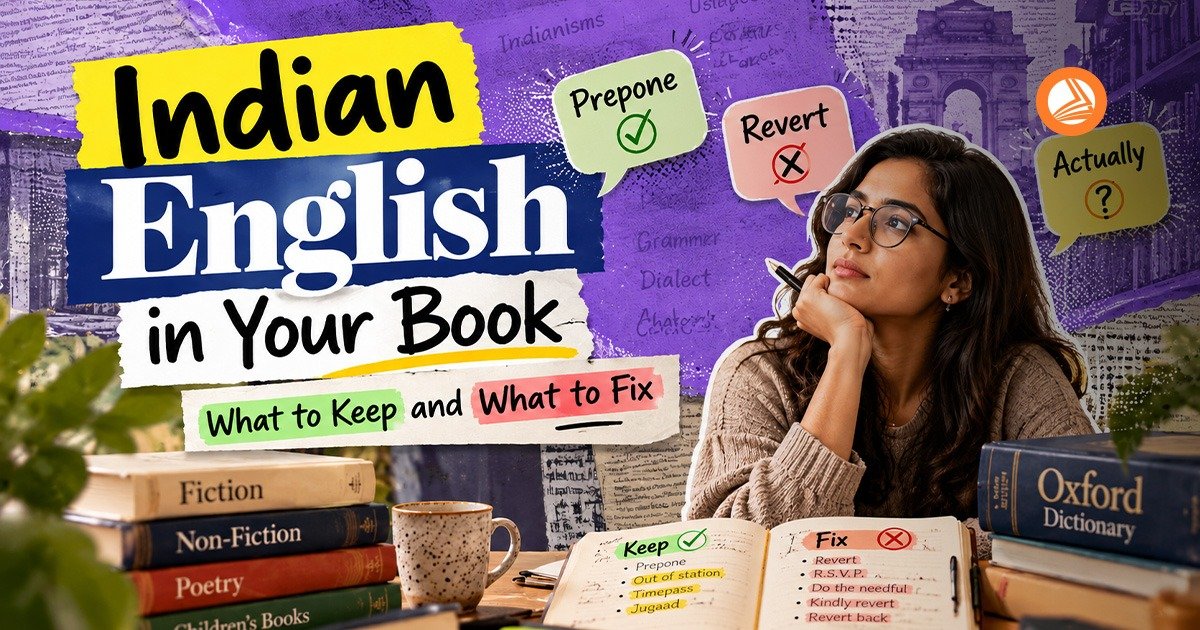
Nine things in this paragraph would catch an editor’s eye. Only three of them are mistakes.
Myself Priya. I passed out from Delhi University in 2019 and joined a startup doing jugaad fixes for rural clinics. Last year I preponed my wedding because Amma was unwell, and my cousin said he will revert about the catering. We had budgeted ₹8 lakh. Half of it went on the pandal — pure timepass, if you ask me, but try telling that to the family.
Most guides on this subject split the world in two: correct English, and Indian mistakes. That is both wrong and quietly insulting, and it is why authors hand over a manuscript and get back something that sounds like nobody they have ever met.
The framework
🔍 Three Categories, Not Two
Sort every flagged word into one of three piles and the whole problem becomes manageable.
Voice
Legitimate Indian English, much of it already in the Oxford English Dictionary. An editor who removes this is damaging the book.
Error
Genuine mistakes that happen to be common here. Nothing to do with being Indian — a British author’s list is the same length with different entries.
Choice
Neither right nor wrong. Lakh or million, ₹ or Rs, italics or not. Decide once and hold it for two hundred pages.
The third pile is where authors actually get stuck, and almost nobody writes about it.
The green pile
✅ Keep It — This Is the Book’s Voice
This is not a matter of taste. The Oxford English Dictionary carries more than 380 Indian English entries, with 26 added in 2020 alone. If someone has told you your English is not correct, there is a fair chance they did not check.
Prepone went into the OED in 2010. It is not slang and it is not a mistake — it fills a gap no other variety of English has a word for. Try saying it in three words instead and you will see why it survived.
Timepass is the neater example: two perfectly ordinary English words compounded into a concept no other English has a single word for. That is not broken English. That is English doing what it has always done.
The same protection extends to the words that carry relationships. Amma, Didi, Bhaiya, Uncle, Auntie, the -ji on the end of a name. Translating Amma into Mother does not clarify anything — it removes the warmth and replaces it with a dictionary definition.
The red pile
❌ Fix It — These Are Just Errors
Copy-editing, not cultural correction. Every variety of English has a list like this; these are the ones that come up most often in Indian manuscripts.
Do the needful deserves its own line. It is not an error, and it is charming in an email. In a book it is almost always covering for a sentence the author has not written yet — what, exactly, needs doing? Say that instead.
The amber pile
⚖ Decide Once, Then Hold It
None of these has a right answer. All of them have a wrong approach, which is changing your mind on page ninety.
The one worth thinking about
✨ To Italicise, or Not
The old rule was simple: italicise every non-English word. That convention has been shifting, and it is worth understanding why before you follow it.
Italicised
Amma sent dabba to the office again, packed with thepla and a small steel bowl of achaar.
Roman
Amma sent dabba to the office again, packed with thepla and a small steel bowl of achaar.
Read them one after the other. The first sentence keeps pointing at itself — three small flags saying this word is foreign. But foreign to whom? In a book set in India, in a kitchen in India, those are the ordinary names of ordinary things. The second sentence simply describes a lunchbox.
There is no rule here and the major style guides accommodate both. Our view: decide deliberately, and when in doubt, do not italicise. Reserve italics for the job they do everywhere else in your book — emphasis, and titles of works. If a reader cannot follow a word, the fix is the sentence around it, not a change of typeface.
On the page
💬 Nobody in India Speaks One Language at a Time
This is where the instinct to clean up does the most damage. Rendering Indian speech as pure, uniform English is not more polished — it is less true, and readers feel it even when they cannot name what is missing.
“Arre, you finished the whole thing? In one night only?”
“What to do. Deadline was Monday.”
Nothing in that exchange needs a glossary, and no sentence in it is standard English. Both are instantly readable anywhere.
The working rule: carry the meaning in the surrounding English. A word or a phrase in another language is fine when the scene tells the reader what is happening. A full sentence they cannot follow, with no context around it, locks them out — and a reader who feels locked out puts the book down.
The same restraint applies to spelling out accents phonetically. Rendering a character’s English as broken to signal where they are from usually flattens them into a joke. Word choice and rhythm carry origin far better than phonetic spelling does.
If you are writing in Hindi or a regional language rather than in English, the questions are different and our guide to self-publishing in Hindi covers them. For everything after the writing: formatting mistakes, why books fail, and the description that decides who finds it.
Questions
❓ Frequently Asked Questions
▼●Is Indian English acceptable in a published book?
Yes. The Oxford English Dictionary carries over 380 Indian English entries and words like prepone, jugaad and timepass have been in it for years. What matters is the difference between Indian English and plain grammatical error — keep the first, fix the second.
▼●Should I use lakh and crore, or convert to millions?
Either, as long as you are consistent. Lakh is natural and precise for Indian readers. If you expect readers abroad, gloss the first use once and then carry on normally. Converting everything makes the book read like a translation of itself.
▼●Do I need to italicise Hindi words in my book?
No rule requires it, and editorial practice has been moving away from it. Italics mark a word as foreign, which is an odd thing to do in a book set in India. Decide one way, apply it throughout, and keep italics for emphasis and titles.
Your book should sound like you wrote it.
Editing, cover, interior layout, ISBN and distribution across Amazon, Flipkart and Google Play. Over 3,100 authors published, every right retained.