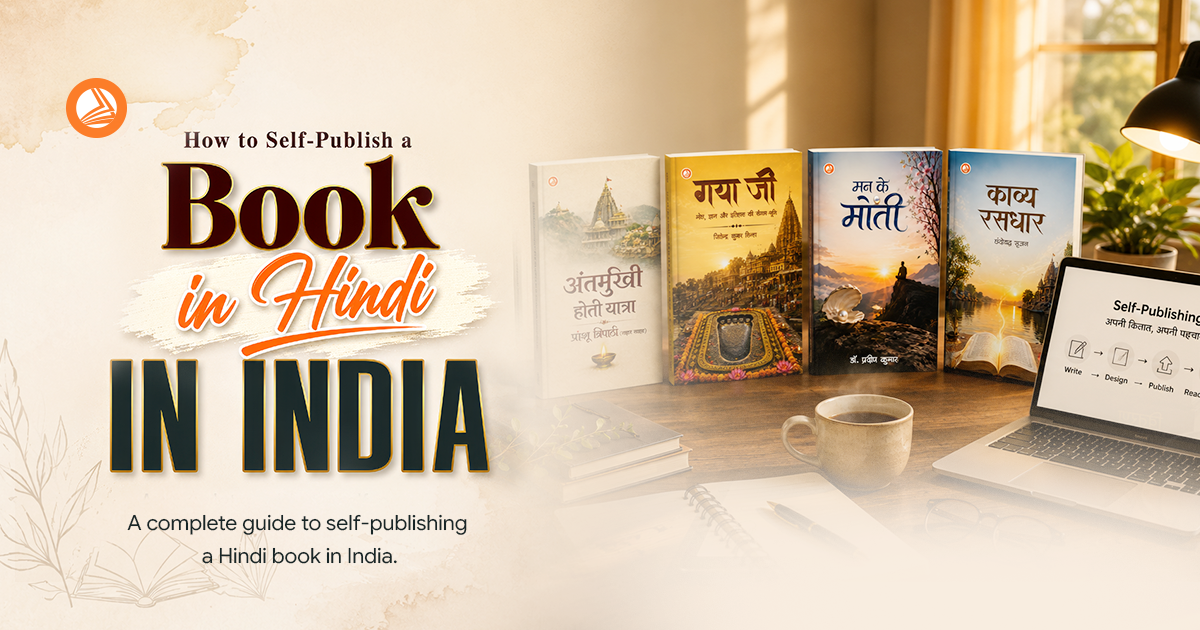
Somewhere in India today, someone is writing in Hindi on a notes app between two metro stops — a novel, a self-help guide, a collection of poems they have carried in their head for years. They are not short of words. They are short of a clear path from manuscript to a book a reader can hold, search for, and buy. That path exists. It is just rarely explained for Hindi the way it is explained for English.
Hindi is, by a wide margin, India's largest reading audience. Over 52.8 crore Indians reported Hindi as their mother tongue in the last available Census, and total speakers — including second-language readers — are estimated well above 60 crore, according to Census of India figures and subsequent demographic analysis. Roughly 45% of all non-textbook book sales in India happen in regional languages, with Hindi at the centre of that share, as reported by the India Brand Equity Foundation (IBEF).
And yet, the self-publishing infrastructure that Indian authors hear about most — Amazon KDP, Kindle Create, Kindle Unlimited — was built primarily around English. It does support Hindi. But it supports Hindi differently, with real gaps that catch first-time Hindi authors off guard. This guide walks through exactly what self-publishing a Hindi book in India involves in 2026: the real rules, the real costs, and the platforms that actually work for Hindi paperback and eBook distribution.
60Cr+
Hindi speakers in India
Census of India, demographic estimates
45%
Non-textbook sales in regional languages
IBEF, 2025
$5.13B
India's book market, 2025
IMARC Group
70%
Royalty on KDP Select sales in India
Amazon KDP
📌 Key Takeaways
✅ Amazon KDP supports Hindi only as an eBook — not as a paperback — so print needs a different route
✅ ISBN is free in India through the government's Raja Rammohun Roy National Agency, but allow 2–4 weeks for approval
✅ KDP accepts Hindi manuscripts only as Microsoft Word (.doc/.docx) files — not PDF — and font choice matters more than people expect
✅ Indian platforms like Notion Press, Pothi.com, and OrangeBooks fill the Hindi paperback gap that Amazon leaves open
✅ Self-help, spirituality, poetry, and regional fiction currently show the strongest reader demand in Hindi
Why Is Hindi Self-Publishing Growing Right Now?
For years, getting a Hindi book published meant approaching one of a handful of established Hindi publishing houses — and waiting, often for a "yes" that never came, regardless of how good the manuscript was. Traditional Hindi publishing in India has historically been concentrated among a small number of houses with limited annual slots, which meant most Hindi writers simply never got read outside their immediate circle.
That gatekeeping problem hasn't gone away, but the alternative to it has matured. India's eBook readership has grown to an estimated 55–65 million active users as of 2025, expanding at more than 15% a year, according to IMARC Group's India book market research. Regional language poetry specifically has shown some of the sharpest growth in the trade segment, with industry trackers citing year-on-year increases of around 25% in Hindi and Bengali poetry sales. None of this is a coincidence — it is the direct result of cheaper smartphones, falling data prices, and a reading public that was always there but never had affordable, dignified access to print and digital formats in its own language.
Self-publishing removes the waiting room entirely. You decide what gets written, how it looks, and when it reaches readers — and for a Hindi author, that often means reaching a hometown, a state, or a dialect-specific readership that a Delhi-based national publisher was never going to prioritise in the first place.
The One Thing Every Hindi Author Needs to Know About Amazon KDP
Amazon's Kindle Direct Publishing (KDP) platform began accepting Hindi manuscripts in December 2016, alongside Tamil, Marathi, Gujarati, and Malayalam — a genuine milestone for Indian-language self-publishing. Hindi authors can publish an eBook through KDP, distribute it to Amazon.in and other Kindle stores worldwide, and earn up to 70% royalty on Indian sales through the KDP Select programme.
But here is the part most first-time Hindi authors don't find out until they're halfway through uploading: KDP's support for Hindi is eBook-only. Paperback publishing in Hindi is not currently available through KDP, per Amazon's own publishing guidelines. If your goal is a physical Hindi book you can hold, sell at a local store, or gift at a family function, KDP alone will not get you there — you'll need a print-on-demand partner that specifically supports the Devanagari script, which is covered in the platforms section below.
There's a second formatting detail that trips people up: KDP currently accepts Hindi manuscripts only in Microsoft Word (.doc or .docx) format — PDF uploads, which work fine for English, are not supported for Indian-language titles. Amazon has also been candid that Indian-language rendering can behave inconsistently across devices and apps while the platform continues improving this support, so previewing your file carefully before publishing is essential, not optional.
✅ From Our Experience at OrangeBooks
The single biggest avoidable mistake we see in Hindi manuscripts is using an old legacy font like Kruti Dev or DevLys instead of a Unicode font like Mangal or Noto Sans Devanagari. Legacy fonts look fine on the author's own computer but turn into broken, unreadable text the moment the file moves to another device, an eBook reader, or a printing press. Converting a full manuscript from a legacy font to Unicode after the fact is a real, billable headache — it is far easier to simply type in Unicode from the very first page.
Step-by-Step: How to Self-Publish a Hindi Book in India
The mechanics are the same whether you write in Hindi or English — write, edit, format, publish, distribute, market — but each step has a Hindi-specific detail worth knowing before you start.
1. Finish and self-edit the manuscript
Write the full draft in a Unicode Devanagari font from day one. Mixing fonts midway through a 250-page manuscript is the most common production delay we see.
2. Get the manuscript professionally edited
Hindi proofreading needs an editor fluent in the language's grammar conventions, not just a general English-trained editor running a translation pass.
3. Apply for your free ISBN
Register on isbn.gov.in, the Raja Rammohun Roy National Agency's official portal. It's free for every Indian author — apply at least a month before you plan to publish.
4. Format for both eBook and print
Devanagari has tall matras and conjunct characters that need extra line-height and careful margin control — a direct copy of an English template usually looks cramped.
5. Design a cover with a Hindi-first eye
If your title is in Devanagari script, make sure the title font is legible at thumbnail size on a phone screen — most book discovery now happens on a 6-inch display.
6. Choose your platform(s)
Most Hindi authors need at least two platforms — one for the eBook (KDP) and a separate print-on-demand partner for the paperback. See the comparison below.
7. Price for your actual readers
Hindi readers are typically more price-sensitive than English readers. A ₹149–₹299 paperback range converts far better than pricing modelled on English titles.
How Much Does It Cost to Self-Publish a Hindi Book in India?
There are two realistic paths, and the right one depends on how much of the production work you're equipped to manage yourself.
💻 DIY eBook-only — ₹0
Self-edit, format the .docx file yourself, apply for your own free ISBN, and upload directly to KDP. Zero cost, but no paperback, and formatting quality depends entirely on your own skill with Devanagari typesetting.
📚 Guided publishing — ₹3,500 to ₹46,500+
A publishing partner handles editing, Devanagari-specific formatting, cover design, ISBN coordination, paperback printing, and distribution to Amazon, Flipkart, and other retailers. Price scales with how much editorial and marketing support you want.
For most first-time Hindi authors, the guided path is worth the cost specifically because of the script-handling problem described earlier — a formatting error that isn't caught before printing means reprinting an entire batch, which costs far more than getting it right the first time.
📖 Avoiding script and layout errors matters even more for Hindi books than English ones: 5 Book Formatting Mistakes That Scream Amateur (Fix Them Now) →
Which Genres Work Best for Hindi Readers Today?
✅ Strong reader demand
Self-help · Spirituality · Poetry · Memoir · Regional fiction rooted in local settings.
⚡ Moderate demand
Literary fiction · Business and career guides · Children's bilingual books.
🚩 Harder to break through
Direct translations of Western genre fiction without an existing Hindi fanbase or local cultural anchor.
"
India's biggest reading audience has been the most underserved by modern self-publishing tools. The opportunity for Hindi authors right now isn't competition — it's catching up to a market that has been waiting for them.
— OrangeBooks Editorial Team
How Do You Market a Self-Published Hindi Book?
Publishing the book is only half the work. Hindi readers don't discover new authors the same way English readers do, so a marketing plan copied from an English self-publishing checklist usually underperforms. Amazon's search and category system in India is still optimised primarily around English and Hindi keywords together, so your book's title, subtitle, and description should include searchable Hindi terms written in both Devanagari and Roman transliteration — readers often search using English letters even when looking for a Hindi book.
The most effective channels for Hindi books tend to be community-driven rather than purely algorithmic. WhatsApp groups built around literature, regional Facebook reading communities, and Hindi BookTube and YouTube review channels carry real weight with this audience. State-level literary festivals — and smaller, city-specific kavi sammelans and book fairs — remain genuinely effective for building early credibility, something that's harder to replicate for English titles competing in a far more crowded online space.
A launch sequence that works well in practice: a soft pre-launch on personal social media and family/alumni WhatsApp groups, a short excerpt shared on a Hindi literary Facebook page or blog, a 5-day free or discounted promotion if you're enrolled in KDP Select, and at least one local event — a college, library, or community hall reading — within the first month. None of this requires a large budget. It requires consistency, and a clear sense of exactly which readers your specific book is for.
📖 Need the full ISBN process before you launch? ISBN Registration in India: Complete Guide for Authors 2026 →
How OrangeBooks Helps Hindi Authors Self-Publish
OrangeBooks Publication manages the full Hindi self-publishing process: Devanagari-aware editing and proofreading, interior formatting that respects the script's spacing needs, cover design, ISBN coordination through the Raja Rammohun Roy National Agency, print-on-demand paperback production, and distribution to Amazon, Flipkart, and Kindle.
You retain 100% ownership of your manuscript and title at every step. See our complete publishing cost guide for a full breakdown of what's included at each price point.
📚 More from OrangeBooks Blog
Frequently Asked Questions
Can I publish a Hindi paperback directly on Amazon in India?▼
Not currently. Amazon KDP supports Hindi eBooks but not Hindi paperbacks. For print, you'll need a print-on-demand partner like Pothi.com, Notion Press, or OrangeBooks, which can then list the paperback on Amazon.in as a seller listing.
Is ISBN compulsory to self-publish a Hindi book in India?▼
It's not legally mandatory for every format, but it is essential for credibility and for listing on major bookstores and libraries. It's free in India through the Raja Rammohun Roy National Agency — apply on isbn.gov.in well ahead of your publish date.
Why does my Hindi manuscript look broken on other devices?▼
This almost always means the manuscript was typed in a legacy font like Kruti Dev rather than a Unicode font like Mangal or Noto Sans Devanagari. Legacy fonts display correctly only on the exact computer they were typed on. Re-typing or properly converting to Unicode fixes this permanently.
How much can a self-published Hindi book realistically earn?▼
It varies widely by genre and marketing effort, but Hindi self-help, spiritual, and regional fiction titles with active social media promotion and local community outreach tend to sell consistently better than direct translations with no built-in audience.
Ready to Publish Your Hindi Book the Right Way?
OrangeBooks handles editing, Devanagari formatting, ISBN, printing, and distribution — so your book reaches readers without formatting disasters.