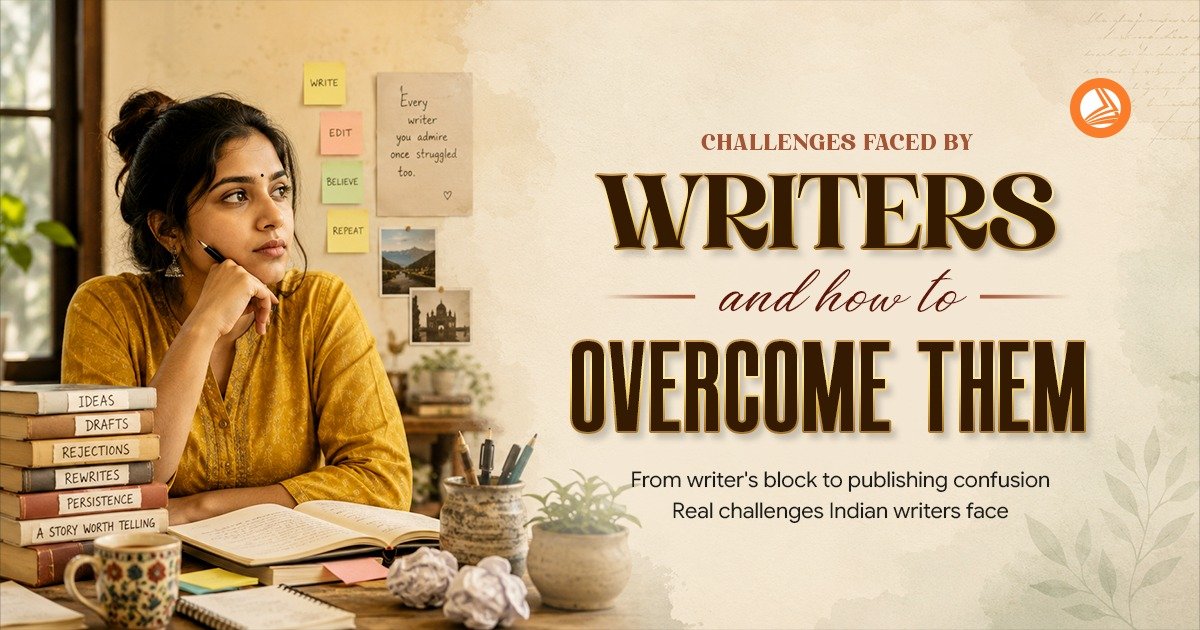
Writing a book is one of the most quietly difficult things a person can do. Not because the individual words are hard — but because the entire journey, from blank page to published book, is full of moments that make you want to stop.
Most writing advice focuses on craft: how to structure a chapter, develop a character, write better sentences. That advice has its place. But the challenges that actually stop writers aren't usually about technique. They're about time, fear, confusion about publishing, and the exhausting middle ground between starting and finishing.
This article addresses the challenges we see Indian authors face most often — and the solutions our editorial and publishing team has found genuinely useful over years of supporting thousands of authors through them.
3,100+
Authors published
OrangeBooks in-house data
72%
First-time authors
Among OrangeBooks authors
#1
Most reported challenge
Finding time to write
2–8 wks
Manuscript to live book
With OrangeBooks support
📌 Key Takeaways
✅ Writer's block is almost always fear in disguise — not a creativity problem
✅ Most authors underestimate how much time structuring and editing take compared to drafting
✅ Publishing has separate steps — ISBN, formatting, copyright, distribution — that each need dedicated attention
✅ Marketing is not optional for self-published authors — but it doesn't have to feel like self-promotion
✅ Indian authors can reach readers globally on Amazon, Apple Books, Kobo, and more — without a foreign publisher
1. Writer's Block — The Page That Won't Let You Begin
Of all the challenges writers describe to us, this is the most persistent — and the most misunderstood. Writer's block is almost never a shortage of ideas. It is usually perfectionism, or the fear that what comes out won't be good enough. The blank page becomes intimidating precisely because the writer cares about what goes on it.
"
The first draft is not supposed to be good. It is supposed to exist. Writers who understand this distinction finish books. Writers who don't, don't.
— OrangeBooks Editorial Team
✅ What Actually Helps
→ Set a 10-minute timer and write without stopping, editing, or lifting your fingers.
→ Start in the middle of the story — not at Chapter 1. The beginning often writes itself once the rest exists.
→ Change your writing environment. A new location resets resistance.
→ Give yourself permission to write badly. The revision stage exists precisely to fix it.
2. Finding Time to Write Around a Full Life
The most common reason authors cite for not finishing a manuscript is not writer's block — it is time. Most of the authors who come to OrangeBooks are working professionals: teachers, engineers, doctors, business owners. Writing a book is something they do in the margins of a life that doesn't naturally have margins.
The solution is not finding more time. It is treating writing as a commitment that doesn't need to compete with everything else. Authors who write daily — even 300 to 500 words — consistently finish faster than those who write in occasional long bursts.
📅 Schedule it like a meeting
Block 30–45 minutes in your calendar. Don't wait for free time — create a recurring appointment with yourself.
🎯 Set word-count goals
300 words a day is a full-length book in a year. A daily word target is more achievable than a time target.
🚇 Use transition time
Commute, early mornings before the family wakes, lunch hour — these are underused writing windows.
📖 We've written a detailed guide specifically on this challenge: How to Write a Book While Working Full-Time: A Practical Guide for Busy Indian Professionals →
3. Self-Doubt and Imposter Syndrome
"Who am I to write a book?" This question — in some form — is almost universal among first-time authors. It shows up mid-manuscript, just when the initial excitement has worn off and the finish line still seems far away. Imposter syndrome doesn't mean you're not a writer. It means you care enough about the work to be afraid of doing it badly.
Author story — Roshan Prasad
Roshan Prasad started writing his first book in 2011. He finished it in 2016. It was published in 2019. Five years, start to finish — much of that time lost to doubt about whether his niche subject (philately) deserved a book at all. His second book with OrangeBooks went from manuscript to global distribution in months. The difference wasn't talent. It was finding the right support and committing despite the doubt.
Read Roshan's full publishing story →The practical fix: stop trying to write a good book and focus on writing a useful one. If even one reader finishes your book and finds it valuable, you have succeeded. That is a lower bar than "good" — and far more achievable.
4. Structuring a Book That Doesn't Fall Apart in the Middle
Many first drafts start strongly and collapse around the 40% mark. This is the "sagging middle" — and it happens almost exclusively to writers who began without a structural plan. Having ideas is not the same as knowing how to organise 50,000 words into something a reader will follow to the end.
Structural Frameworks — Which to Use
| Three-Act Structure | Fiction & memoir. Setup → Confrontation → Resolution. Universal and proven. |
| Problem–Solution | Self-help, business, how-to. Most effective non-fiction framework. |
| Chapter-as-Promise | Each chapter = one reader question answered. Clear, reader-led structure. |
| The Reverse Outline | Written after the draft — identifies gaps and restructure without rewriting from scratch. |
For non-fiction authors especially: write a one-sentence summary of each planned chapter before you begin writing any of them. If you cannot summarise it in a sentence, the chapter does not yet have a clear enough purpose.
5. Knowing When the Manuscript Is Ready — and How to Edit It
Two failure modes exist here: authors who over-edit for years and never publish, and authors who publish too quickly and regret it. The difference between a first draft and a publish-ready manuscript is not a feeling — it is a process. And that process almost always includes a professional editor.
✅ The 4-Pass Edit Model
Structure → Content → Line edit → Proofread. Each pass has a different purpose. Don't try to do all four at once.
⏳ The 2-Week Rule
Take at least 2 weeks away after finishing your draft before reading it again. Fresh eyes catch what familiarity hides.
👥 Beta Readers First
3–5 readers from your target audience before professional editing reveals structural problems — cheaply.
✅ From Our Experience at OrangeBooks
The manuscripts that need the least revision at proofreading stage are those where the author took a deliberate break between drafting and editing. The books published in a rush are the ones authors later wish they could update — and poor early reviews on Amazon are very difficult to recover from.
📖 Formatting is where many authors lose credibility after editing well: 5 Book Formatting Mistakes That Scream Amateur (Fix Them Now) →
6. Understanding the Publishing Process
Publishing has its own language — ISBN, copyright, interior formatting, eBook conversion, distribution, metadata — and none of it is taught anywhere. Most first-time authors encounter these terms after finishing their manuscript, which means they are learning a new skill set at the most stressful possible moment.
The Self-Publishing Process — In the Right Order
| Manuscript editing | Developmental → line edit → proofread. Do this before anything else. |
| ISBN registration | ISBN registration in India is free, but authors must send four printed copies of their book to designated national libraries. If submitted correctly, the process typically takes 7–15 days to complete. |
| Cover design + formatting | Interior layout for print + eBook conversion. These are two separate deliverables. |
| Distribution | Amazon, Flipkart, Apple Books, Kobo + 150 countries via print-on-demand. No upfront inventory needed. |
📖 For the ISBN step specifically: ISBN Registration in India: Complete Guide for Authors 2026 →
📖 Still deciding between self-publishing and traditional? Self-Publishing vs Traditional Publishing in India 2026 →
7. Fear of Criticism and Negative Reviews
Many authors hold back from publishing — sometimes for years — because the thought of a critical review is more frightening than not being read at all. This is a normal fear. And it gets significantly easier to manage once you've published once and experienced that negative reviews don't end anything.
Not every critical review is the same. Some contain genuine feedback that can improve your next book. Most are simply the natural result of the fact that no book appeals to every reader. The authors we see thrive after publishing are those who read reviews for signal, not for approval.
A useful frame
One useful piece of feedback from a one-star review is worth more than ten five-star reviews that say "loved it." Your critical reviewers are often your most useful editors for the next book. Read them once, extract the signal, and move on. Peer-reviewed research on Indian e-commerce confirms that even 3–4 genuine reviews on an Amazon listing significantly improve conversion from browser to buyer.
8. Marketing a Book Without Feeling Like a Salesperson
Marketing is the challenge most authors wish they didn't have to think about — and the one that most directly determines how many people actually read their book. Most self-published books in India sell fewer than 100 copies in their first year. Not because the writing is poor. Because the author finished the book, shared one post, and then waited.
The reframe that helps most: marketing is not about selling your book. It is about connecting your book to the readers who need it. WhatsApp is the most underrated tool for Indian authors — it is entirely free, and your personal network is far more likely to buy, share, and review than any stranger online.
Before launch
Share cover reveal, a chapter excerpt, the story behind why you wrote the book. By launch day, your audience should already be curious.
Launch week
Post daily with a different angle each day. WhatsApp broadcast, Instagram, LinkedIn, Facebook — adapt tone per platform.
90 days after
Most authors go quiet here. This is the single biggest mistake. Your launch creates awareness. The 90 days after create actual sales momentum.
📖 The exact playbook, built from real OrangeBooks authors: How to Sell Your First 100 Copies of Your Self-Published Book in India →
9. Reaching Readers Beyond Your Immediate Circle
One of the most persistent misconceptions among Indian authors is that self-publishing means publishing for your personal network. It does not. Amazon KDP, Apple Books, Kobo, and IngramSpark distribute to 150+ countries. A well-produced book from an author in Pune or Hyderabad sits on the same digital shelf as one published by an author in London. What matters is not where you are. It is whether your book has a professional cover, clean formatting, a proper ISBN, accurate metadata, and a description written for search.
✅ What OrangeBooks handles for global reach
→ ISBN registration (required for all international retail)
→ Print and eBook formatting to platform specifications
→ Distribution to Amazon, Flipkart, Apple Books, Kobo, and 150+ countries via print-on-demand
→ Packages start at ₹6,000 with transparent pricing and no hidden fees
Frequently Asked Questions
How long does it realistically take to write a book? ▼
For a first-time author writing a non-fiction book (40,000–60,000 words), a realistic timeline is 6 to 12 months from first draft to publish-ready manuscript. Authors who write daily — even 300 words — consistently finish faster than those who write in occasional long bursts. Fiction often takes longer.
Do I need a professional editor if I'm self-publishing? ▼
Yes — at minimum a proofreader. Self-editing is limited by familiarity; you read what you intended to write, not what is on the page. A professional editor consistently improves reader reviews and reduces post-publication regret. Poor early Amazon reviews are very difficult to recover from.
What is the single biggest mistake first-time authors make? ▼
Publishing too quickly, without editing. The excitement of finishing a manuscript is real — but a book that goes to readers before it is ready is very difficult to recover from. The investment in editing almost always pays for itself in reader reception.
Is self-publishing taken seriously in India? ▼
Increasingly, yes. What readers notice is the quality of the book — not how it got published. A well-edited, well-designed self-published book is indistinguishable from a traditionally published one. The Indian book market crossed USD 10.37 billion in 2024 and is growing at nearly 6% annually — and more than 70% of books in India are sold online, which means the playing field is more level than it has ever been.
📚 More from OrangeBooks Blog
Your book deserves to be read. We'll help you get it there.
OrangeBooks supports Indian authors through every step — editing, formatting, ISBN, distribution, and marketing. Over 3,100 authors and counting. Packages start at ₹6,000.
This article was written by the OrangeBooks Editorial Team — publishing industry experts, editors, and author advocates who have supported over 3,100 Indian authors through the self-publishing process. For publishing enquiries, contact our team or register for a free consultation.