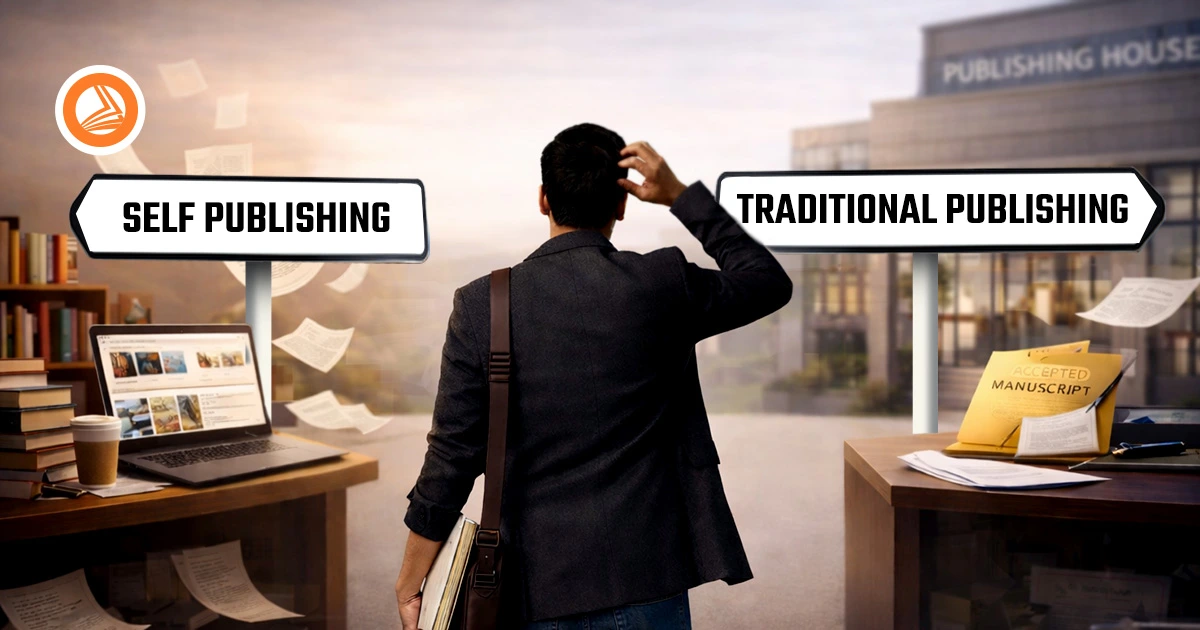
You've finished your manuscript. You've polished every sentence, refined every chapter, and now you're ready to share your work with the world. But here's where most authors hit a wall: Do I go the traditional publishing route or self-publish?
It's not a simple choice — and anyone who tells you otherwise hasn't really thought it through. Both paths have real advantages and real trade-offs. The question isn't which one is "better" — it's which one is better for you, given your book, your goals, and your situation.
This guide breaks down everything you need to know about self-publishing vs traditional publishing in India in 2026 — from costs and timelines to creative control and long-term earnings. By the end, you'll know exactly which path makes sense for your book.
|
📊 Quick Answer
Self-publishing gives you speed, control, and higher royalties. Traditional publishing gives you industry validation, distribution muscle, and upfront advances (if you're lucky).
Most first-time authors in India find self-publishing to be faster, more profitable, and more empowering — especially with a professional partner like OrangeBooks handling the heavy lifting.
|
|
📌 Article Summary
This guide compares self-publishing vs traditional publishing for Indian authors in 2026. Key takeaways: Self-publishing offers 2-8 week timelines vs 12-24 months, 100% profit retention vs 8-15% royalties, and complete creative control. Traditional publishing provides zero upfront cost but lower earnings and loss of rights. For most authors, self-publishing with professional support (like OrangeBooks) combines speed, control, and profitability.
|
What is Traditional Publishing?
Traditional publishing is the "old-school" route where you submit your manuscript to a publishing house, wait for acceptance, and — if you're one of the lucky few — they handle everything: editing, design, printing, distribution, and marketing. In exchange, they take most of the profits and retain significant control over your book.
How it works in India:
| 1.You submit your manuscript to publishers (sometimes via agents) |
| 2.Publishers review submissions (can take 6-12 months, often longer) |
| 3.If accepted, you negotiate a contract (or sign what they offer) |
| 4.Publisher edits, designs, prints, and distributes your book |
| 5.You receive royalties (typically 8-15% of net sales) |
What is Self-Publishing?
Self-publishing means you control every aspect of bringing your book to market — either by doing it yourself or by hiring professionals to handle specific tasks. You invest in the process upfront, but you also keep the rights, make all creative decisions, and earn significantly higher royalties.
How it works in India:
| 1.You hire professionals or partner with a self-publishing company like OrangeBooks |
| 2.Your book is edited, designed, formatted, and printed to professional standards |
| 3.Your book goes live on Amazon, Flipkart, Kindle, and global platforms |
| 4.You handle (or outsource) marketing and promotion |
| 5.You earn 100% of the profit margin after printing and platform fees |
The Key Differences: Side-by-Side Comparison
Here's what actually matters when choosing between the two paths.
| Factor |
Traditional vs Self-Publishing |
| Timeline to Market |
Traditional: 12-24 months (often longer)
Self-Publishing: 2-8 weeks |
| Upfront Costs |
Traditional: ₹0 (publisher pays)
Self-Publishing: ₹15,000-₹80,000+ (author pays) |
| Royalties |
Traditional: 8-15% of net sales
Self-Publishing: 100% of profit margin |
| Creative Control |
Traditional: Publisher decides title, cover, editing
Self-Publishing: You control everything |
| Rights Ownership |
Traditional: Publisher retains significant rights
Self-Publishing: You retain 100% of rights |
| Distribution |
Traditional: Bookstores + online (selective)
Self-Publishing: Amazon, Flipkart, Kindle + 150 countries |
| Marketing Support |
Traditional: Minimal (unless you're a celebrity)
Self-Publishing: You handle it (or hire experts) |
| Acceptance Rate |
Traditional: ~2-5% of submissions accepted
Self-Publishing: 100% (you decide when to publish) |
|
📊 Key Stat: Self-published authors in India earn 5-10x more per book sold compared to traditional publishing royalties (₹100-300 vs ₹20-40 per copy).
|
What Traditional Publishing Offers
Let's be fair — traditional publishing does have some genuine benefits, especially if you're lucky enough to land a deal with a reputable house.
|
No Upfront Investment
The publisher pays for editing, design, printing, and distribution. You don't spend a rupee out of pocket.
|
|
Industry Validation
Being "traditionally published" still carries prestige in literary circles and can open doors to awards, reviews, and media coverage.
|
|
Potential Advance Payment
Some publishers (not all) offer an upfront advance against future royalties — though advances in India are typically small (₹25,000-₹1,00,000 for debut authors).
|
|
Bookstore Distribution
Traditional publishers can get your book into physical bookstores — though this is increasingly less important as readers shift to online platforms.
|
The Downsides of Traditional Publishing
The downsides are significant — and for most authors in India, they outweigh the benefits.
⏰ Extremely Long Timeline
From submission to publication can take 1-2 years or longer. Your book idea may become stale, markets shift, and life moves on while you wait. |
📉 Very Low Royalties
Typical royalty is 8-15% of net sales (after retailer cuts). You might earn ₹20-40 per book sold, while the publisher earns much more. |
🚫 Loss of Creative Control
Publishers often demand significant edits, change titles, and dictate cover design. Your book becomes "their product." |
📜 Rights Ownership Issues
Many traditional contracts include clauses that restrict your ability to publish related content, film rights, or future editions independently. |
⚠️ Rejection is the Norm
95-98% of manuscript submissions are rejected. Most never even get read beyond the first page. |
|
📊 Industry Reality: Only 2-5% of manuscripts submitted to traditional Indian publishers get accepted. Self-publishing acceptance rate is 100% — you decide when you're ready.
|
Why Self-Publishing Works for Most Indian Authors
For most authors today — especially in India's fast-moving, digital-first market — self-publishing offers far more control, speed, and profitability.
|
⚡ Speed to Market
Your book can be live on Amazon and Flipkart within 2-8 weeks — not years.
|
|
💰 Much Higher Earnings
You keep the full profit margin after printing and platform fees — often 5-10x what traditional publishers pay per book sold.
|
|
🎨 Total Creative Control
You decide the title, cover, price, and every word inside. Your vision stays intact.
|
|
📚 You Own All Rights
Film rights, translation rights, audiobook rights — everything stays with you forever.
|
|
📈 Direct Reader Data
You see real-time sales data, reader reviews, and can adjust pricing or marketing strategies instantly.
|
|
🌍 Global Distribution
With platforms like Amazon KDP and OrangeBooks, your book reaches 150+ countries instantly.
|
|
💡 OrangeBooks Self-Publishing Advantage: We handle the professional work — editing, design, ISBN, distribution — while you retain 100% of rights and keep full profit margins. Get all the benefits of traditional publishing quality with none of the downsides. Explore our packages →
|
The Trade-offs of Self-Publishing
To be fair, self-publishing isn't perfect either. Here's what you should know.
Upfront Investment Required
You'll need ₹15,000-₹80,000 depending on the level of professional help. However, this is an investment, not a cost — you earn it back with higher royalties. |
Marketing is Your Responsibility
Traditional publishers don't actually market most books either — but the perception is different. You'll need to drive awareness yourself or hire marketing support. |
Less "Prestige" in Literary Circles
Some awards and review outlets still favor traditionally published books — though this stigma is rapidly disappearing as self-published bestsellers become common. |
Which Path Should You Choose?
Here's the honest truth: for most authors in India in 2026, self-publishing is the smarter choice. But let's look at when each path makes sense.
✅ Choose Self-Publishing If:
You want your book published quickly (within weeks, not years) • You value creative control and ownership • You want to earn more per book sold • You're comfortable investing upfront for long-term returns • You're writing non-fiction, business books, or niche topics |
✅ Consider Traditional Publishing If:
You have zero budget and can't invest anything upfront • You're willing to wait 1-2+ years • Industry validation matters more to you than earnings • You're writing literary fiction targeting award circuits • You have connections or an agent who can help you get accepted |
How OrangeBooks Combines the Best of Both Worlds
At OrangeBooks Publication, we've built a self-publishing model that gives you all the advantages of professional publishing — expert editing, design, distribution — while keeping you in full control of your rights and profits.
|
The OrangeBooks Approach
|
| ✓Professional-grade editing, design, and formatting |
| ✓ISBN registration and legal compliance handled for you |
| ✓Distribution on Amazon, Flipkart, Kindle, and 150+ countries |
| ✓Print-on-demand + bulk printing options |
| ✓You keep 100% of your rights — forever |
| ✓You earn the full profit margin after costs |
| ✓Optional marketing, website, and book trailer add-ons available |
|
Ready to Publish Your Book the Smart Way?
Skip the rejection letters and 2-year wait times. Get your book professionally published, distributed globally, and earn what you deserve — all while keeping full rights and control.
Get Free Publishing Consultation View Packages & Pricing |
The Bottom Line
Traditional publishing made sense in 1995. In 2026, for most authors in India, self-publishing is faster, more profitable, and gives you complete control over your creative work.
The question isn't really "traditional vs self-publishing" anymore. The real question is: Do you want to self-publish alone, or with professional support?
With OrangeBooks, you get the best of both worlds — professional quality without giving up rights, speed without sacrificing standards, and full profit margins without doing everything yourself. Let's talk about your book →
Frequently Asked Questions
The main difference is control and profit. In traditional publishing, a publisher handles everything but takes most profits (you get 8-15% royalties) and controls creative decisions. In self-publishing, you invest upfront, keep 100% of rights and profits, and control every aspect of your book. Self-publishing in India typically costs ₹15,000-₹80,000 upfront but results in 5-10x higher per-book earnings.
Traditional publishing takes 12-24 months or longer from submission to publication. Self-publishing with OrangeBooks takes 2-8 weeks from manuscript to having your book live on Amazon, Flipkart, and global platforms. This speed advantage allows you to publish while your content is still relevant and timely.
Self-publishing earns significantly more per book sold. Traditional publishers typically pay 8-15% royalties on net sales (₹20-40 per book). With self-publishing through OrangeBooks, you keep 100% of the profit margin after printing and platform costs — often ₹100-300+ per book depending on price and format. Most authors break even within the first 100-200 copies sold.
Yes, absolutely. Many authors self-publish first to build an audience and sales track record, then use that success to negotiate better traditional publishing deals later. Self-publishing with OrangeBooks is non-exclusive — you retain all rights and can explore traditional publishing whenever you want. Some successful self-published authors even get approached by traditional publishers.
No. Quality depends entirely on the professionals you work with, not the publishing method. Books self-published through OrangeBooks receive the same professional editing, design, and formatting services that traditional publishers provide. The difference is you maintain control and higher earnings. Many bestselling books on Amazon India are self-published with professional quality that rivals or exceeds traditionally published books.
OrangeBooks provides end-to-end professional self-publishing services including editing, cover design, formatting, ISBN registration, print-on-demand, and distribution to Amazon, Flipkart, Kindle, and 150+ countries. Unlike traditional publishers, you keep 100% of rights and profits. Packages start at ₹6,000 with transparent pricing and no hidden fees.
View our packages or
get a free consultation.