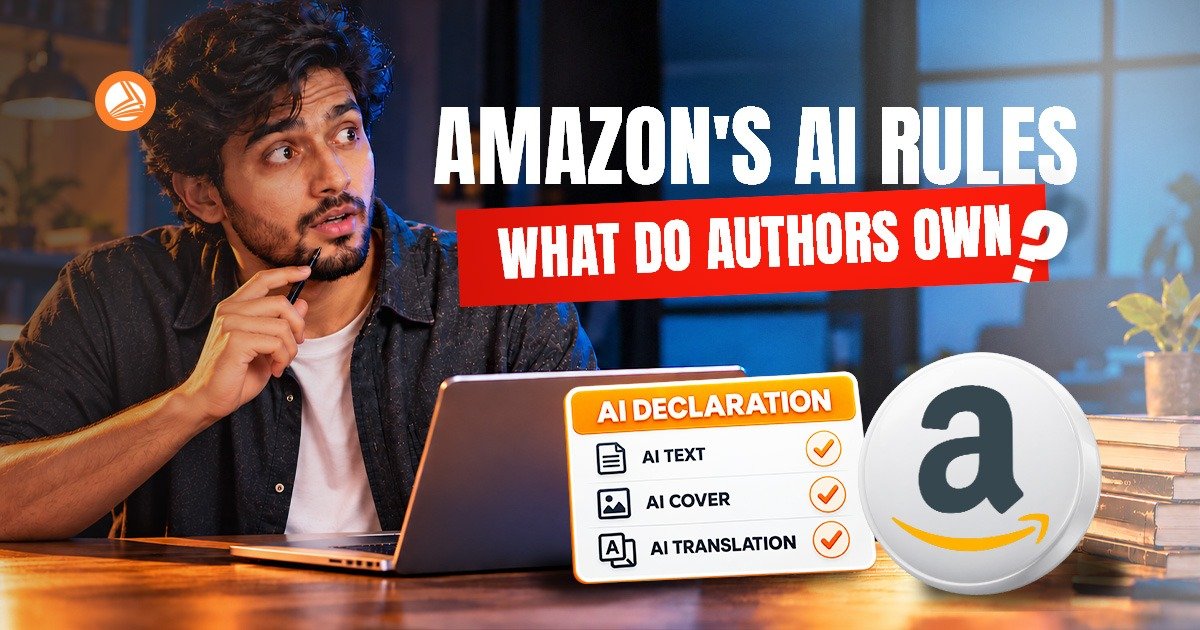
There are two risks in using AI to write a book, and almost everything published on the subject covers only the first one.
Risk one
Amazon can take the book down, and in some cases close the account it was published from.
Risk two
Under Indian copyright law, a book written mostly by a machine may not be yours to own in the first place.
The first is a policy problem with a simple fix. The second is an ownership problem, it is specific to India, and hardly anyone is talking about it. Both are worth ten minutes of your time before you publish.
First, the good news
✅ You Are Allowed to Use AI
Amazon has not banned AI-written books. It has asked you to say so. That is the entire policy in one sentence, and the panic circulating in author groups is mostly built on not knowing it.
When you publish or republish, you are asked whether the book contains AI-generated content — text, cover art, interior images or translation. You tick the box. That is it.
The part that calms most people down: the declaration is internal to Amazon. It is not printed on your product page, not shown in the listing, and no reader ever sees it. Nobody is going to buy your book and find a label on it.
What breaches the terms is not using AI. It is using it and not saying so.
The distinction that matters
🧮 Generated, or Assisted?
Amazon draws one line and everything follows from it. AI-generated means an AI produced the initial draft or the initial image — even if you edited it heavily afterwards. That must be declared. AI-assisted means you made the thing and used AI to check, refine or brainstorm around it. That does not.
Most authors get this wrong in both directions. Some declare nothing when they should. Others are convinced a grammar checker has disqualified them. Here are the situations that actually come up.
The pattern: who made the first version? If it was a machine, say so. If it was you, the machine was a tool, the same as a dictionary or a spellchecker, and nobody needs to know.
If you say nothing
⚠ What Actually Happens
Amazon does not take your word for it. Detection runs on writing patterns, on the metadata attached to your files, and on how fast an account is publishing. Flagged titles go to human review.
Undisclosed AI-generated content breaches the terms, and enforcement has tightened through 2025 and 2026. The outcomes, in ascending order of pain: a warning, a title blocked from sale, or the account itself suspended. An account suspension takes every book published from it, not only the one that triggered the review.
The 2026 changes went further and tightened how often an account can upload new titles. Publish a run of books in quick succession and you may be asked to verify that the work is original. This is aimed at the people flooding the store with machine-written titles, but it catches genuinely prolific authors too, so it is worth knowing before you plan a six-book year.
Worth noting whose account is carrying that risk. If the KDP account is in your own name — which is how we set it up — the exposure is yours, and so is the decision. None of which is a reason to avoid AI. It is a reason to tick the box. The declaration costs nothing, changes nothing a reader sees, and removes the risk entirely.
The harder question
⚖ Do You Actually Own It?
Amazon’s rules are about permission to sell. Indian copyright law asks something else entirely, and the answer is less comfortable.
The Copyright Act, 1957
An author, under Indian law, has to be a natural person.
Not a company, not a tool, not a model. A human being.
The Copyright Office has already shown what this means in practice. In the Suryast matter it registered an artwork made with an AI tool, with the human applicant and the AI listed together in the authorship details — and then issued a withdrawal notice, on the grounds that authorship must be attributed to a natural person.
There is a provision in the Act for computer-generated works, where the author is the person who causes the work to be created. That phrase is doing a great deal of work, and it is precisely what is being argued over now. The direction through 2026 is reasonably clear: where a human supplies only a prompt and the machine makes the creative decisions, the output is increasingly treated as having no human author — and a work with no author may have no protection.
Think about what that means for a book. If it is not protected, there is nothing to stop somebody reprinting it, translating it, or putting their own name on it. You would have no copyright to assert, because none was ever created.
The practical read. A book you wrote, with AI helping you think and tidy, is yours in the ordinary way — the creative decisions were human. A book where you wrote prompts and the machine wrote the pages sits in genuinely uncertain territory, and the uncertainty is not in your favour.
This is general information and not legal advice — we publish books, we are not lawyers. The law here is moving. If a book of yours carries real commercial weight, take proper advice on it. Our guide to who owns your book covers the ordinary position.
The counterweight
💡 Where AI Genuinely Earns Its Place
None of the above is an argument against using it. Used on the right side of that line, AI is the most useful thing to happen to a working author in years — particularly one writing around a job, which is most Indian authors.
🔎 Research and fact-checking
Finding what has already been written on your subject, and catching a claim you half-remembered. Verify anything that matters — it will invent citations.
🧩 Arguing with your outline
Ask it where the structure sags, what a sceptical reader would object to, which chapter is doing no work. It is a patient first reader.
✏ Tightening what you wrote
Cutting a 400-word passage to 250 without losing the sense. Genuinely good at this, and it stays your writing.
💬 Blurbs and descriptions
Twenty options for a back-cover line so you can see what you dislike. Declare it if the final text is the machine’s.
🌐 A translation first pass
A draft for a human translator to correct is faster than starting cold — but declare it if the published translation is substantially the machine’s work.
📝 Getting unstuck
Three possible openings at eleven at night, so tomorrow does not begin with a blank page.
Every one of those keeps the creative decisions with you, which is exactly what both Amazon’s policy and Indian copyright law are asking about. If you are writing around a full-time job, our guide on finishing a book while working pairs well with this, and once the book exists, your description and keywords decide who ever finds it.
Questions
❓ Frequently Asked Questions
▼●Will readers see that I used AI?
No. The declaration goes to Amazon and stays there. It does not appear on your product page, in the listing, or anywhere a reader can see it.
▼●Does using AI for grammar or editing count?
No. If you wrote the text and used AI to check, refine or tighten it, that is AI-assisted and needs no declaration. The line is who produced the first version.
▼●Can I copyright a book written with AI in India?
The Copyright Act, 1957 requires an author to be a natural person, and the Copyright Office withdrew a registration in the Suryast matter on exactly that basis. A book you wrote with AI assisting is yours in the ordinary way. A book the machine largely wrote sits in uncertain territory. This is general information, not legal advice — take proper advice if it matters commercially.
Publishing a book you wrote yourself?
ISBN in your name, editing, cover, print and distribution across Amazon, Flipkart and Google Play. Over 3,100 authors published, every right retained.