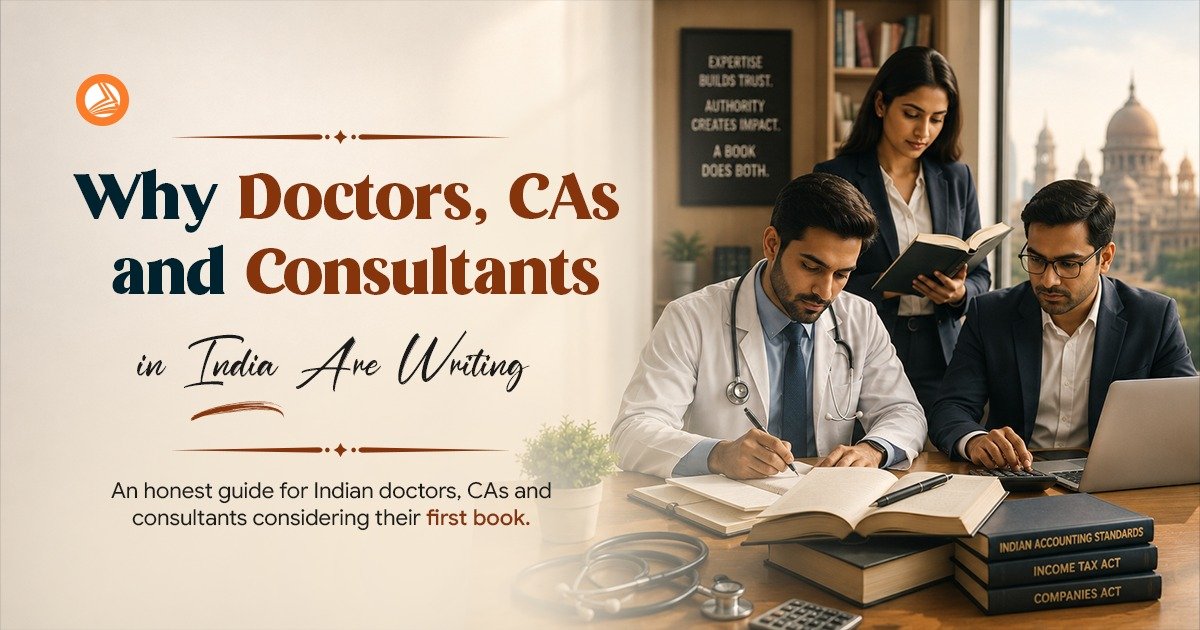
For doctors, CAs, lawyers and consultants
A book will not make you money. It will make you the obvious choice.
Somewhere in your field is a colleague with the same qualifications, the same years of practice, roughly the same skill. When a patient, client or conference organiser has to break the tie, something must. In India, increasingly, that something is a book with your name on it.
An honest guide for the Indian professional with fifteen years of expertise and a nagging sense they should put it in a book. What it does for a practice, what it costs, how people with full calendars finish one — and who should not write one yet.
1What a Book Actually Does for a Practice
Set royalties aside. For a practising professional a book is a credibility asset, not a revenue product, and it pays in a different currency. Books are hard to fake — anyone can claim expertise on a website, but very few will defend a position for two hundred pages. Here is where the return shows up.
Trust before you meet
A patient or client who has read your book arrives already convinced. The consultation starts somewhere else.
Speaking invitations
Conference committees shortlist authors. The book is the credential that puts you on the panel instead of in the audience.
Media that quotes you
Journalists need an expert with a verifiable position. Authorship makes you findable and safe to quote.
Better referrals, not just more
Peers send the complex cases to whoever wrote the book on it. The quality of work changes, not only the volume.
Room to set your fee
Published authority changes the conversation about price. You stop being comparable on rate alone.
Institutional standing
Curricula, hospital libraries, professional bodies and boards treat published work as a different class of evidence.
2Four Who Already Did It
Not hypotheticals. Each published with OrangeBooks while holding down a demanding career.
RJ
Dr. Rakesh Joshi
Eye surgeon · 35 years
Two books on Retinitis Pigmentosa, English and Hindi, because patients kept leaving clinics believing nothing could be done. Now a TEDx speaker.
His story →KA
CA Kumar Anand
Chartered accountant · CFO
Eighteen years leading finance globally. His book was featured at the New Delhi World Book Fair 2026 and earned a national media interview.
His story →NK
Major (Dr.) Navjeet Kaur
Psychologist · Army veteran
Years of counselling couples became a book on the seven marriage vows, launched at Punjab Kala Bhawan with Gurpreet Ghuggi present.
Her story →YD
Yugal Prem Das
Engineer · Spiritual coach
Three books with OrangeBooks, now part of university curricula across Maharashtra — the clearest proof of what institutional standing looks like.
His story →3Which Kind of Book Is Yours?
Professionals stall here more than anywhere else. There are four options. Pick by who you want to reach.
The explainer book
Reaches: your patients or clients
Takes the thing you explain twenty times a week and explains it once, properly. Easiest to write, strongest word of mouth.
The practitioner guide
Reaches: others in your field
Smaller audience, far higher standing. This is the one that reaches curricula, libraries and professional bodies.
The professional memoir
Reaches: a general readership
Your career as a story — what the work taught you about people. Widest reach, most likely to earn media coverage.
The framework book
Reaches: your market position
Names and codifies your method. Best for consultants and coaches — the framework becomes the thing clients ask for by name.
4"I Don't Have Time"
Nobody with a full practice has a spare afternoon. The professionals who finish do not find more time — they lower the daily requirement until it fits the life they already have.
Three hundred words a day produces a 55,000-word manuscript in about six months. That is one focused half hour, or a fifteen-minute dictation between appointments. The ones who fail are almost always waiting for a free weekend that never arrives.
What we see work, again and again
The professionals who finish fastest almost never type their first draft. They talk it. A doctor dictates between consultations, a consultant records on the drive home, a CA speaks a chapter into a phone once audit season ends. Speaking is faster than typing — and for an expert it is more natural, because you have explained this material out loud hundreds of times already. Transcribe first. The editing is where the book is actually written.
For the full system — daily targets, commute dictation, outline frameworks — see our guide on writing a book while working full-time.
5What It Costs, What Comes Back
Be clear-eyed about the money. Professional self-publishing in India runs from a few thousand rupees for a bare-bones edition to the mid five figures for full editorial, design and distribution support. Our complete cost guide breaks down every line item.
What you put in
Six to nine months of short daily sessions
Editing, design, ISBN, printing, distribution
A willingness to commit a position to print
What comes back
Clients and patients who arrive already convinced
Speaking slots, media quotes, better referrals
A credential that keeps working for a decade
What you should not do is measure the return in royalties. A book that sells 800 copies has done its job if two of those readers became clients, one conference invited you to speak, and a journalist put your name in a national paper. As a publishing venture that looks modest. Against what the same money buys in advertising, it is not close.
One thing to insist on, whoever you publish with: you keep the rights and the royalties. At OrangeBooks every author retains 100% of both. A book is your reputation in printed form — it should never sit on somebody else's balance sheet.
6Are You Ready? An Honest Check
We would rather say this plainly than take on a project that disappoints. Read both columns. If more of the left applies than the right, wait a year.
Wait if
✗ You are hoping for passive income. Wrong instrument.
✗ You have no position that differs from the standard view.
✗ You are under five years into the work.
✗ You cannot protect six months of small daily sessions.
Start now if
✓ You explain the same thing every single week.
✓ You disagree with your field on something defensible.
✓ People already ask you to speak.
✓ What you know is written down nowhere.
Frequently Asked Questions
Will a book make me look self-promotional to my peers?
It depends entirely on what the book does. A book that teaches something useful reads as a contribution. A book that lists your achievements reads as a brochure. Write to solve a reader's problem and the credibility follows on its own — peers respect the work, not the marketing around it.
How long does it take a working professional to write a book?
Six to nine months for a first draft at 300 words a day, plus two to three months for editing, design and production. The ones who finish work in short daily sessions or dictate between appointments.
Do professional books actually sell, or is it only about credibility?
Both, unevenly. Explainer books sell steadily for years because the need keeps recurring. Practitioner guides sell in smaller numbers at higher value. Either way, the durable return for a working professional is the authority, not the royalty.
You have the expertise. We build the book around it.
OrangeBooks has published 3,100+ authors — doctors, chartered accountants, psychologists, engineers and consultants among them. Editing, design, ISBN, printing and worldwide distribution, with transparent pricing and full royalty clarity. You keep every right.
+91-810-964-5082 · info@orangebooks.in