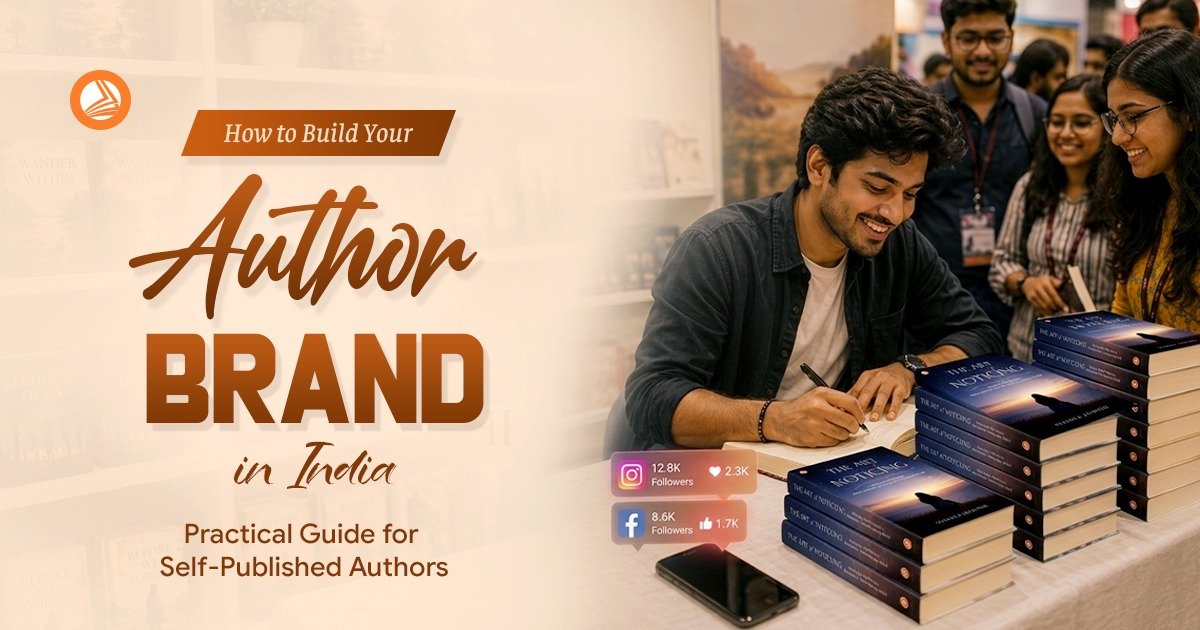
Most Indian authors hear "author brand" and imagine something they cannot afford — a designer logo, a themed Instagram grid, daily content, a large following. So they skip it entirely and wonder why their book is not finding readers.
Here is the truth: an author brand is not a marketing performance. It is the answer to one simple question that every potential reader asks the moment they encounter your book — who is this person, and why should I trust them with my time?
That question is answered long before anyone reads a single page. It is answered by your bio, your online presence, the consistency of your voice, and whether you look like someone who has something real to say. This guide explains what building an author brand actually requires — and what it does not.
In 2026, author branding has shifted from an optional bonus to an expected part of your publishing journey
Readers today want to connect with the author — it is the person they follow, rarely the book alone
What Author Brand Actually Means
Your author brand is not your logo. It is not your Instagram theme. It is not the number of followers you have. It is the consistent identity you project — the emotional and intellectual impression a reader carries away after encountering your name, your book, or your content anywhere.
Think of it this way: if two people who have never spoken to each other both independently describe you as an author, and they use the same words — "she writes about conscious relationships", "he is the finance guy who makes complicated things simple", "her poetry is about identity and belonging" — then you have a brand. It is the thread that connects your values, your work, and your reader's reason to seek you out.
The simplest test
Google your own name. What does a potential reader find? If the answer is nothing — or a confusing mix of unrelated content — your author brand does not exist yet. That is what this guide helps you build.
Why It Matters More in India in 2026
India published over 90,000 new titles last year. Most of those books are discovered online — on Amazon India, through Google searches, through social media recommendations. In that environment, a book without a recognisable author behind it is competing purely on cover and description against hundreds of similar titles.
Authors with a clear identity have a different kind of advantage. Their book is not just a product — it is an extension of someone readers already know something about. Every professional they have impressed on LinkedIn, every reader who has followed their Instagram, every person who has heard them speak, every WhatsApp contact who knows them as an expert in their field — all of these become natural readers, reviewers, and amplifiers. That network does not appear by accident. It is built before the book launches.
5 Elements Every Author Brand Needs
None of these require a large following. None require daily posting. All of them require clarity — and consistency over time.
1. One Clear Territory
Your territory is the answer to: what is this author known for? Not your genre label — that is too broad. Your specific angle within it. A parenting author might own "raising emotionally resilient children in Indian households." A business writer might own "first-generation entrepreneurs navigating family and ambition." A poet might own "identity and displacement for the Indian diaspora."
The narrower and clearer your territory, the more strongly the right readers will connect with you. Trying to appeal to everyone produces a brand that resonates with no one. Write down your territory in one sentence. If it takes a paragraph, it is not clear yet.
2. A Professional Author Bio
Your bio appears in three places that matter — on your book's back cover, on Amazon Author Central, and on your social profiles. Most authors write a bio once, carelessly, and never revisit it. A strong bio does four things in 100–150 words: establishes your credibility for this specific subject, names your territory, shows something human and specific about you, and tells the reader what you have published.
✅ What makes a bio work
Specific credentials over vague claims. "15 years as a senior cardiologist at AIIMS" builds more trust than "passionate about health." Name the subjects you write about. End with one personal detail that makes you a person, not just an authority.
3. Presence on One or Two Platforms — Not All of Them
The most common mistake new authors make is trying to be everywhere at once — Instagram, LinkedIn, Facebook, Twitter, YouTube — and doing all of them poorly. Pick one or two platforms where your actual readers spend time, and show up there consistently.
Best for professionals, business authors, educators, coaches, non-fiction. India has 115M+ users — the highest-trust platform for credentials.
Best for poets, fiction authors, lifestyle, memoir, self-help. The Indian Bookstagram community is engaged and genre-specific.
Best for community-building, regional language authors, older demographics, and book groups. Strong for testimonials and launch engagement.
Underrated for Indian authors. A broadcast list of 100 trusted contacts who know your work is more powerful than 10,000 cold followers.
Consistency means more than frequency. Posting once a week with substance — a real insight, a behind-the-scenes moment from writing, a short extract, a reader's response — will always outperform daily empty posts. Readers want to feel they know you, not that you are running a promotional channel.
4. An Amazon Author Central Page
This is free, takes under an hour to set up, and is the single most overlooked author brand asset. When a reader clicks your name on an Amazon book listing, they land on your Author Central page. If it is empty — no photo, no bio, no other books — the opportunity to build trust is lost. If it is complete, it does the work of convincing the reader to buy without any additional effort from you.
Set up your Amazon Author Central India page at author.amazon.in. Add a professional photograph, your full bio, your website link, and your social profile. Every book you publish gets listed there automatically once you claim it. This page compounds in value with every book you add.
5. Visual Consistency Across Your Book and Profiles
You do not need a designer or a brand style guide. You need one professional photograph used consistently — on your book, on Amazon, on LinkedIn, on Instagram — and a cover design that belongs to your genre. When the visual identity is coherent, readers who see your book on Amazon and then find you on social media recognise you immediately. When it is inconsistent, even small visual mismatches undermine trust.
If you are publishing a series or plan to publish multiple books, discuss visual consistency with your designer at the first book stage. A consistent spine and cover style across titles creates a recognisable author presence on Amazon listings — which is one of the clearest signals of a serious, established author.
What You Do Not Need
More damaging than having no author brand is being paralysed by a mistaken idea of what building one requires. Let us be direct about what you do not need:
You do not need a large following. We have published authors at OrangeBooks with under 500 Instagram followers who sold more books in the first month than authors with 10,000 — because their 500 followers were genuinely interested in their subject.
You do not need to post every day. Consistency beats frequency. An author who posts one genuinely useful insight per week for a year builds far more trust than one who floods feeds for a month and then disappears.
You do not need to create a separate persona. The most effective author brands in India are simply the author being themselves — professionally, with clarity about what they write and who they write for.
You do not need to start after your book is published. The best time to start is six months before launch. The second best time is right now — even if your book is already live.
OrangeBooks Authors Who Built Their Brand
Across 3,100+ authors we have worked with, the ones who sustain their sales beyond the launch month share one consistent characteristic — they were findable before someone decided to buy. Not because they were famous. Because they had a clear territory, a professional online presence, and enough of a digital footprint that a curious reader could answer the question: who is this person?
Major (Dr.) Navjeet Kaur built her brand around the intersection of military discipline and relationship psychology — a territory so specific that when her book on the seven marriage vows launched, her audience already existed. Yugal Prem Das built his around spiritual wisdom for modern practitioners — which is why his books entered university curricula. Neither of them needed a massive following. They needed a clear, consistent identity that their right readers could recognise.
That is what author brand building is. It is not performance. It is clarity — sustained long enough for the right people to find you. For more on how to sell your book once your brand starts generating interest, see our guide on selling your first 100 copies. And if you are still deciding whether to publish, here are the 10 questions to ask any publisher before signing.
Your Book Is the Beginning of Your Brand — Not the Whole of It
At OrangeBooks, we support 3,100+ authors not just through publishing — but through building the presence that makes publishing worth it. Talk to our team about what comes after the book.
📞 +91-810-964-5082 | 📧 info@orangebooks.in
Related Guides
📦 How to Sell Your First 100 Copies
Your brand brings readers in. Here is what converts them into buyers and reviewers.
Read the guide →⭐ How to Get Book Reviews in India
A clear brand makes review outreach easier — here is the full strategy for building honest reviews.
Read the guide →⚠️ Why Most Self-Published Books Fail
No author presence is one of six reasons books underperform — here are all of them.
Read the guide →